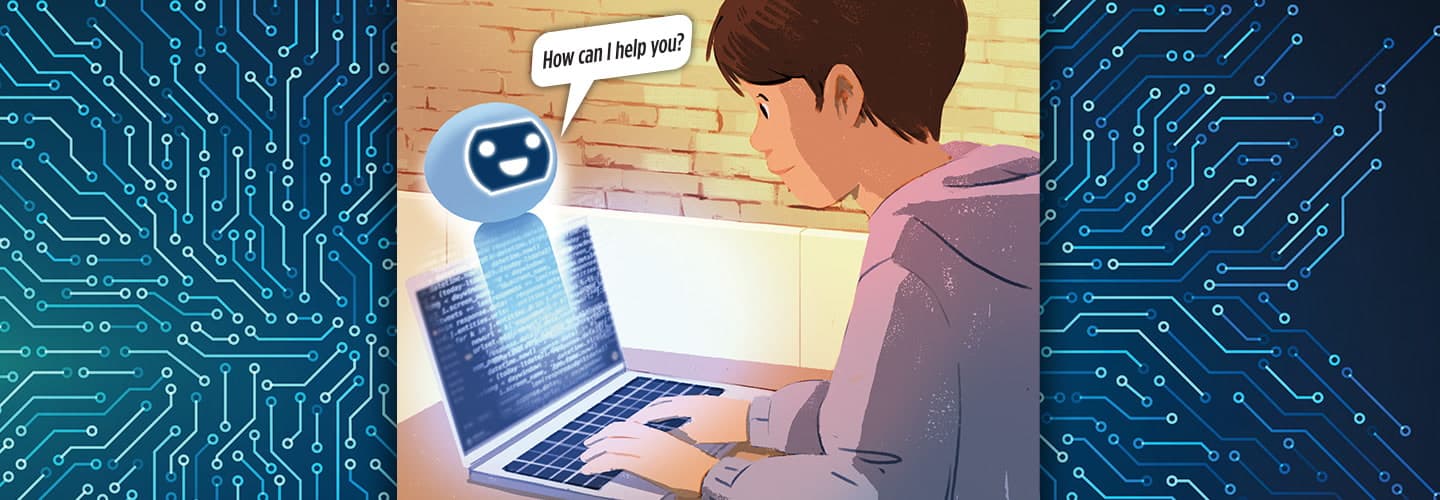

Composite image of a boy typing on a laptop while a smiling robot face glows above the screen

Illustration by Oriol Vidal; Shutterstock.com (background)

Standards

Does AI Belong in Schools? 

Artificial intelligence is just about everywhere. Schools across the U.S. are deciding whether that should include classrooms. 

These days, everyone seems to be talking about artificial intelligence, or AI. You’ve probably used AI, even if you don’t realize it. The videos suggested by YouTube? When Alexa and Siri talk to you? That’s AI at work. AI also provides results when you use search engines like Google. 

But what exactly is it? AI refers to the ability of machines to do tasks that usually require human thought and problem-solving skills. Some of the most common AI tools are chatbots, like Gemini, Claude, and ChatGPT. They can answer countless questions, write stories, tell jokes, and more. In 2025, ChatGPT replied to more than 2.5 billion prompts per day. 

As AI becomes a bigger part of our lives, schools are deciding how to deal with it. Some limit the use of AI or don’t allow it at all. New York City Public Schools, the nation’s largest district, has banned elementary and middle school students from using AI. 

Meanwhile, other places are welcoming AI into classrooms. For example, Utah has made AI tools available to every public school in the state. 

Why are there different rules? AI can be helpful, but it also does questionable things that have some educators worried. 

Lately, lots of people are talking about artificial intelligence, or AI. You’ve probably used AI without even knowing it. The videos suggested by YouTube? When Alexa and Siri talk to you? That’s AI at work. AI also provides results on search engines like Google. 

But what exactly is AI? AI refers to the ability of machines to do tasks that usually require human skills. Some of the most common AI tools are chatbots. These include Gemini, Claude, and ChatGPT. They can answer countless questions. They write stories, tell jokes, and more. In 2025, ChatGPT replied to more than 2.5 billion prompts per day. 

AI is becoming a bigger part of our lives. Now schools are deciding how to deal with it. Some are limiting AI use. New York City Public Schools is the nation’s largest district. It has banned AI use for kids in elementary schools. 

But other places are bringing AI into classes. Take Utah, for example. AI tools are available to every public school in the state. 

Why are there different rules? AI can be helpful. But it also does some things that has teachers worried.

What You Need to Know About AI
Watch a video to learn about ways AI is changing the world.

What Can You Trust?

Ask a chatbot a question, and you’ll have an answer almost instantly. It’s no wonder that many students have turned to chatbots as study buddies. More than 70 percent of kids ages 9 to 12 say they’ve used AI for schoolwork at least once. That’s according to a 2026 report by Common Sense Media. 

But experts warn that you should be skeptical of chatbot responses. Why? They aren’t always right! AI tools gather information from billions of webpages, including books, news articles, videos, and even social media posts. These sources sometimes have incorrect information. 

“If you think about the information on the internet, some of it is credible, but a lot of it is not,” says Hannah Covington. She’s a media expert at the News Literacy Project. 

Ask a chatbot a question. You’ll have an answer almost instantly. That’s why many kids have used chatbots as study buddies. More than 70 percent of kids ages 9 to 12 say they’ve used AI for schoolwork at least once. That’s according to a 2026 report by Common Sense Media. 

But experts say you should be skeptical of chatbots. Why? They aren’t always right! AI tools take information from billions of pages online. They include books, news articles, and videos. They even include social media posts. These sources can be incorrect.

“If you think about the information on the internet, some of it is credible, but a lot of it is not,” says Hannah Covington. She’s a media expert at the News Literacy Project. 

42 percent of kids don't realize that AI can't tell the difference between what's true and what's false. 

Source: Common Sense Media

And relying on AI can hurt your ability to actually learn. Even though AI can help you think, it shouldn’t do the thinking for you. Students who simply ask AI for answers skip doing the hard work needed to solve problems.

“AI doesn’t give kids the opportunity to make a mistake and then learn from it,” says fifth-grade teacher Leeana Cruz Moran. Her school in New Jersey allows kids to use AI in class. 

Source: Common Sense Media

And using AI can hurt your ability to truly learn. AI can help you think, but it shouldn’t do the thinking for you. Asking AI for answers means skipping the hard work needed to solve problems.

“AI doesn’t give kids the opportunity to make a mistake and then learn from it,” says Leeana Cruz Moran. She is a fifth-grade teacher. Her school in New Jersey allows kids to use AI in class.  

Using AI Safely

Still, many teachers say AI can be useful as long as students use it properly and understand its limits. AI tools are designed to respond confidently—even when they’re wrong. So it’s up to users to stop and think about what AI is telling them. 

“A good first step is asking yourself ‘Have I checked the information I’ve been given, or am I just trusting it at face value?’” Covington explains. 

Knowing how to use AI the right way can also keep kids out of trouble. It can be tempting to use AI to cheat. After all, it’s easy to go from using a chatbot to brainstorm ideas for an essay to having it write the whole essay for you. But teachers aren’t easily fooled! They can usually tell when students have used a chatbot.

Still, many teachers say AI can be useful. But that’s only if students understand its limits. AI tools are built to respond confidently—even when they’re wrong. So it’s up to users to stop and think about what AI is saying. 

“A good first step is asking yourself ‘Have I checked the information I’ve been given, or am I just trusting it at face value?’” Covington says. 

Knowing how to use AI properly can also keep kids out of trouble. It can be tempting to use AI to cheat. At first, you might use a chatbot to think of essay ideas. Later, you might end up having it write the whole essay for you. But teachers aren’t easily fooled! They can usually tell when students have used chatbots. 

Into the Future

Even if you aren’t using AI in school, you’ll likely encounter it in many other places. And it’s becoming a key part of many jobs. A 2025 study found that almost 90 percent of employers worldwide think working with AI will become a more important skill in the future. 

“AI is not going away,” says Cruz Moran. “We want to make sure kids know how to use it responsibly.”

Even if AI isn’t in your school, you’ll likely see it in other places. And it’s becoming a key part of many jobs. Almost 90 percent of employers worldwide think working with AI will be a more important skill in the future. That’s according to a 2025 study. 

“AI is not going away,” says Cruz Moran. “We want to make sure kids know how to use it responsibly.”

Online Research Do's and Don'ts

Here are some tips for finding information online you can trust—whether you’re using AI or not.

Here are some tips for finding information online you can trust—whether you’re using AI or not.

  • DON'T rely only on the top search result. If it’s an AI overview, you’re only getting a summary of different webpages on the topic—and not all webpages are reliable.
  • DO keep scrolling through the results so you can compare sources. 
  • DON'T click on every link you see. Sites run by trusted news organizations or universities (ending in .edu) are usually good places to start.
  • DO use multiple trusted sources. Facts should always be confirmed by more than one reliable source.
  • DO ask a teacher or another trusted adult if you aren’t sure a source is reliable. 

1. Based on the article, what are some ways you think you use AI in everyday life?

2. What are two reasons that many educators worry about students using AI for schoolwork?

3. What point is Leeana Cruz Moran trying to make when she says “AI is not going away”?

1. Based on the article, what are some ways you think you use AI in everyday life?

2. What are two reasons that many educators worry about students using AI for schoolwork?

3. What point is Leeana Cruz Moran trying to make when she says “AI is not going away”?

videos (2)
videos (2)
Skills Sheets (3)
Skills Sheets (3)
Skills Sheets (3)
Games (1)
TEACHER SUPPORT (1)
Leveled Articles (1)
Text-to-Speech