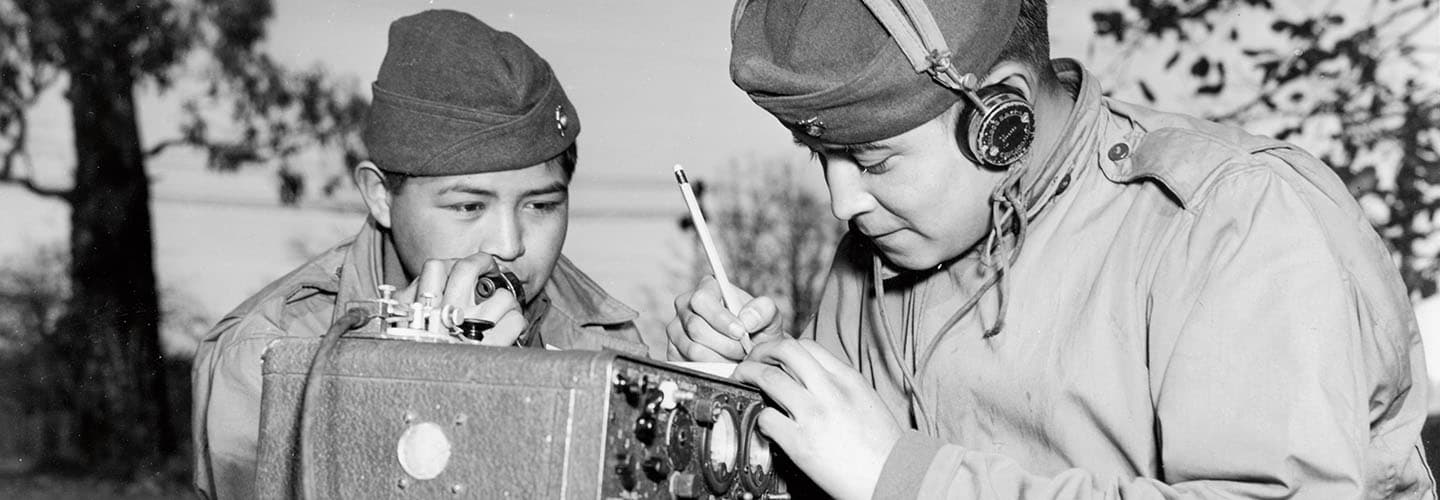

Historical photo of a soldier speaking into a radio handset as another in headphones writes notes

Navajo code talkers send secret messages over a radio during World War II.

U.S. National Archives 

Standards

Unbreakable

A top-secret code created by Navajo men helped the United States win World War II.

The Code That Couldn't Be Broken
Watch a video to learn more about the Navajo code talkers.

The air was dusty with bullets. There was smoke everywhere. I saw an airplane get shot down. 

That’s how Thomas Begay recalls February 19, 1945—one of the scariest days of his life. He had just arrived on Iwo Jima, a small Japanese island. It would become the site of one of the deadliest battles of World War II (1939-1945).

Though he was surrounded by enemy fire, Begay knew he had an important job to do. He was part of a small group of Navajo code talkers who stormed the beach at Iwo Jima. They’d use a secret code created from their Native language to help win the battle—and the war. 

The air was dusty with bullets. There was smoke everywhere. I saw an airplane get shot down. 

That’s what Thomas Begay says about February 19, 1945. It was one of the scariest days of his life. He had just arrived on a Japanese island called Iwo Jima. It was the site of one of the deadliest battles of World War II (1939-1945).  

Begay was surrounded by enemy fire. He had an important job to do. He was part of a small group of Navajo code talkers who attacked the beach at Iwo Jima. They used a secret code created from their Native language. They would help win the battle—and the war.

Jim McMahon/Mapman®

A Secret Weapon

Begay is a member of the Navajo Nation (see sidebar). His exact birth date is unknown. He grew up in New Mexico, where his family spoke only Navajo. As a young boy, Begay knew just one English word: his first name.

That changed after he was sent to a boarding school when he was about 13. Hundreds of thousands of Native children attended similar schools, where they were forced to give up their cultures and forbidden from speaking their Native languages.

While Begay was at school, Japan attacked the U.S. military base in Pearl Harbor, Hawaii. The next day, December 8, 1941, the U.S. entered World War II. 

Begay wanted to sign up for military service, but he was too young. In August 1943, when he was about 17, he enlisted in the U.S. Marine Corps. When he got to training camp, he found out he was going to be a code talker. 

The U.S. military needed a secret code to send messages that the Japanese couldn’t decipher. If the enemy figured out the code, the lives of U.S. troops could be at risk. 

Because so few people spoke Navajo, the Marine Corps decided the language was the perfect starting point to build a secret code. Navajo men who had once been punished for speaking their Native language would now use it to help win a war.

Begay spent months memorizing each code word and helping create new ones. By the end of the war, the code had more than 500 words. 

Begay is a member of the Navajo Nation (see sidebar). No one knows his exact birth date. He grew up in New Mexico. And his family spoke only Navajo. As a child, Begay knew just one English word: his first name.

That changed after he was sent to a boarding school. He was about 13. Hundreds of thousands of Native children were at similar schools. There, they were forced to give up their cultures. They were not allowed to speak their Native languages.

Begay was at school when Japan attacked Pearl Harbor. That’s a U.S. military base in Hawaii. The next day, December 8, 1941, the U.S. entered World War II. 

Begay wanted to join the military, but he was too young. When he was about 17, he joined the U.S. Marine Corps. That was in August 1943. At training camp, he found out his job. He would be a code talker. 

The U.S. military needed a code. That way, it could send messages that the Japanese couldn’t decipher. If the enemy figured out the code, the lives of U.S. troops could be at risk. 

Very few people spoke Navajo. So the Marine Corps decided it was the perfect language to start building a secret code. Navajo men had once been punished for speaking their Native language. But now they would use it to help win a war. 

Begay memorized each code word and helped create new words. It took months. By the end of the war, the code had more than 500 words.

Courtesy of Thomas H. Begay (Begay during WWII); Ross D. Franklin/AP Images (Begay today)

Thomas Begay during World War II and today

On the Battlefield

In February 1945, it was time for Begay to put his training into action on Iwo Jima. The island was defended by about 20,000 Japanese soldiers. As bullets whizzed by, Begay carried his heavy radio and other equipment across the island. In the first two days of the battle, he and the other code talkers sent more than 800 messages. 

“It was nonstop, calls coming in and going out all the time,” he says. “All the communication came through us.”

After more than a month of fighting, the U.S. won the battle. 

In February 1945, Begay put his training into action. Iwo Jima was defended by about 20,000 Japanese troops. As bullets flew by, Begay carried his heavy radio across the island. In the first two days of the battle, code talkers sent more than 800 messages. 

“It was nonstop, calls coming in and going out all the time,” he says. “All the communication came through us.”

After more than a month of fighting, the U.S. won the battle.

Sworn to Secrecy

Japan surrendered in August 1945, bringing World War II to an end. Its code breakers never figured out the Navajo code. 

The heroism of the code talkers was kept secret for more than 20 years. The military didn’t want anyone to know about the code in case it was needed again. It was finally declassified in 1968.

In 2001, Begay and the other Navajo code talkers received medals from the U.S. Congress in honor of their service. Begay is proud of the important role he played in the U.S. victory in World War II.

“I didn’t ask to be a code talker,” he says. “But I was a Navajo at a time when the United States needed Navajos.”

World War II ended after Japan surrendered in August 1945. Its code breakers never figured out the Navajo code. 

For more than 20 years, the bravery of the code talkers was kept secret. The military didn’t want others to know about the code in case it was needed again. It was finally declassified in 1968.

In 2001, the Navajo code talkers were honored for their service. They received medals from the U.S. Congress. Begay is proud of his important role in the U.S. victory in World War II.

“I didn’t ask to be a code talker,” he says. “But I was a Navajo at a time when the United States needed Navajos.” 

What You Need to Know About the Navajo

  • The Navajo Nation has more than 427,000 members. It’s the second-largest Indigenous, or Native, group in the U.S., after the Cherokee Nation.
  • The Navajo call themselves Diné. They call their language Diné bizaad.
  • More than 400 Navajo men served as code talkers during World War II. 
  • Most of the code talkers grew up on or near the Navajo reservation, which is larger than 10 of the 50 states. It stretches across parts of Arizona, Utah, and New Mexico.
  • The Navajo Nation has more than 427,000 members. It’s the second-largest Indigenous, or Native, group in the U.S., after the Cherokee Nation.
  • The Navajo call themselves Diné. They call their language Diné bizaad.
  • More than 400 Navajo men served as code talkers during World War II. 
  • Most of the code talkers grew up on or near the Navajo reservation, which is larger than 10 of the 50 states. It stretches across parts of Arizona, Utah, and New Mexico.

1. According to the article, what problem did the U.S. military face during World War II, and how did the Navajo code talkers provide a solution?

2. Based on what you have read, why do you think the article is titled “Unbreakable”?

3. The word ironic is used to describe an outcome that is exactly the opposite of what might be expected. Why is it ironic that the U.S. government chose the Navajo language for an important code?

1. According to the article, what problem did the U.S. military face during World War II, and how did the Navajo code talkers provide a solution?

2. Based on what you have read, why do you think the article is titled “Unbreakable”?

3. The word ironic is used to describe an outcome that is exactly the opposite of what might be expected. Why is it ironic that the U.S. government chose the Navajo language for an important code?

videos (4)
videos (4)
videos (4)
videos (4)
Skills Sheets (3)
Skills Sheets (3)
Skills Sheets (3)
Games (1)
TEACHER SUPPORT (1)
Leveled Articles (1)
Text-to-Speech