
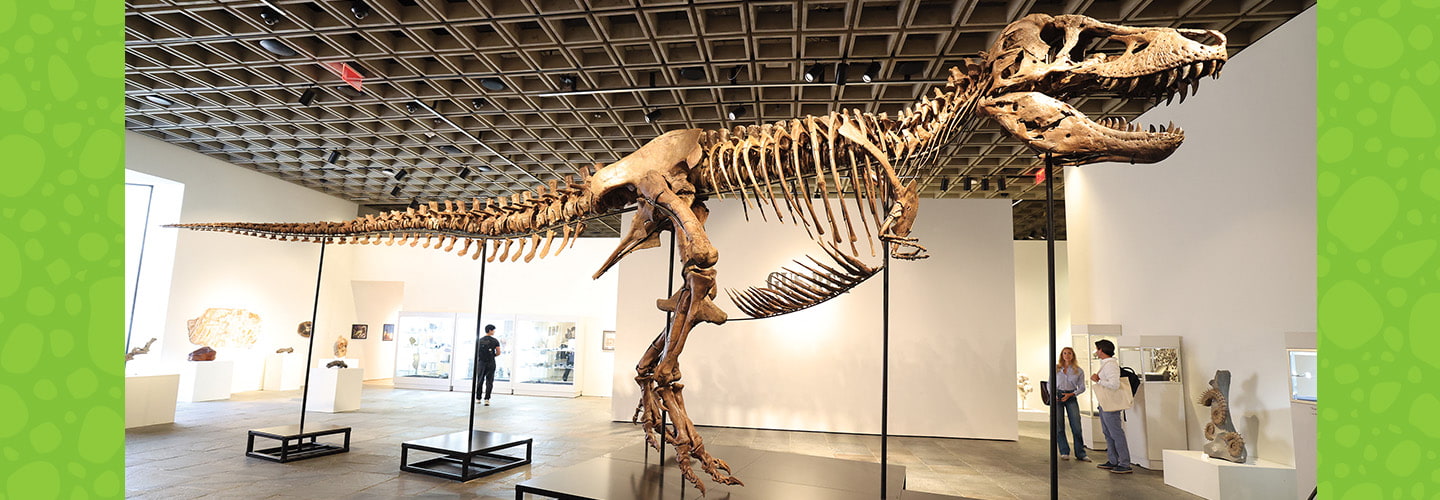

A large dinosaur skeleton on display in a museum gallery with visitors nearby

The record-setting Tyrannosaurus rex Gus is 38 feet long and more than 12 feet tall.

TIMOTHY A. CLARY/AFP via Getty Images (Gus); Shutterstock.com (all other images)

Standards

Should Fossils Be For Sale? 

What Are Fossils?
Watch a video about how fossils form and what they can tell us.

Tyrannosaurus rex is called the king of the dinosaurs. Now it has the price tag to prove it. In July, a T. rex skeleton sold to a mystery buyer for $50.1 million, making it the most expensive fossil ever. The 67-million-year-old dinosaur named Gus is one of the most complete T. rex skeletons ever found. 

Commercial fossil hunters found Gus on a ranch in South Dakota in 2021. They made a deal with the ranch’s owners to sell the prized discovery at an auction, where it would go to the person who bid the most money.

Gus’s sale broke the record that had been set in 2024 by a Stegosaurus named Apex. That skeleton was bought at an auction by a billionaire collector for $44.6 million. 

Some people think these sales will inspire fossil hunters to search for other prehistoric treasures. But the soaring prices of dinosaur bones worry many paleontologists (scientists who study fossils). Collectors often display their fossils in their homes or offices, where scientists don’t have access to them for research.

Tyrannosaurus rex is called the king of the dinosaurs. Now it has the price tag to prove it. In July, a T. rex skeleton sold to a mystery buyer for more than $50 million. It’s the most expensive fossil ever. The 67-million-year-old dinosaur is named Gus. It is one of the most complete T. rex skeletons ever found. 

Commercial fossil hunters found Gus on a South Dakota ranch in 2021. They made a deal with the ranch’s owners. They would sell the fossil at an auction. It would go to the person who bid the most money.

Gus’s sale broke the record set in 2024 by a Stegosaurus named Apex. A billionaire bought Apex at auction for more than $44 million. 

Some people say these sales will inspire fossil hunters to look for other treasures. But the high prices of dinosaur bones worry many paleontologists. Those are scientists who study fossils. Collectors often keep their fossils in their homes. That means scientists don’t have access to them for research.

Should wealthy collectors be allowed to buy dinosaur fossils?

Some people argue that without commercial fossil hunters, rare fossils like Gus might never be found. That’s because museums and universities often can’t afford to pay for excavations, or digs. 

“Fossils that are not collected eventually get destroyed,” says Jacob Jett. He’s the vice president of Triebold Paleontology, a fossil-finding company. “They get eroded by nature.” 

Some people argue that rare fossils might not be found without commercial fossil hunters. Museums and universities often can’t afford to pay for digs.  

“Fossils that are not collected eventually get destroyed,” says Jacob Jett. He’s the vice president of Triebold Paleontology. That’s a company that finds fossils. “They get eroded by nature.”  

57%: Percentage of all T. rex fossils that have been discovered by commercial fossil hunters.*

* As of October 2024; Source: Palaeontologia Electronica, 2025

Some fossil hunters say the money they make from their discoveries is a reward for their skill and years of hard work. Excavating each of Gus’s bones and carefully putting together the skeleton took nearly five years. 

Other people argue that landowners deserve to be paid for fossils that are found on their property.

Fossils owned by collectors sometimes end up in museums anyway. For example, Apex’s owner loaned the skeleton to the American Museum of Natural History in New York City. Researchers are now studying Apex’s bones to learn more about how the dinosaur grew. 

* As of October 2024; Source: Palaeontologia Electronica, 2025

Some fossil hunters say the money they make from sales is a reward for their skill and hard work. Digging up Gus’s bones and putting together the skeleton took about five years. 

Others argue that landowners deserve to be paid for fossils found on their property.

Plus, fossils owned by collectors can still end up in museums. For example, Apex’s owner loaned the skeleton to the American Museum of Natural History. That’s in New York City. Researchers are now studying Apex’s bones. They hope to learn about how the dinosaur grew.

© Nancy Kaszerman/ZUMA Press Wire/Alamy Stock Photo

The Stegosaurus Apex is on loan to the American Museum of Natural History until 2028.

Many paleontologists think museums are the best places for fossils. But most U.S. museums couldn’t even attempt to buy Gus, because the starting bid was $19 million.

“Museums and universities don’t have the kind of money that wealthy individuals have, so they cannot compete,” says paleontologist Stuart Sumida. 

Many paleontologists think fossils should be in museums. But most U.S. museums couldn’t even try to buy Gus. The starting bid was $19 million.

“Museums and universities don’t have the kind of money that wealthy individuals have, so they cannot compete,” says Stuart Sumida. He’s a paleontologist.

$8.4 million: Highest price ever paid by a U.S. museum for a dinosaur skeleton. 

Source: The Field Museum of Natural History

Many people say dinosaur auctions can be a huge loss for science. Fossils are a direct link to prehistoric life on Earth. Though some collectors donate or lend their fossils to museums, many others don’t share them with the public. 

“Fossils teach us about the history of our planet on a huge scale,” says Sumida. “If they’re in private collections, we will never learn about them or from them.” 

Some people think the U.S. should follow the example of countries that have stricter laws to protect fossils. In Brazil, for instance, all fossils belong to the government so they can’t be sold by people who find them. 

Source: The Field Museum of Natural History

Many people say dinosaur auctions can be a big loss for science. Fossils connect us to prehistoric life on Earth. Though some collectors put their fossils in museums, many others don’t share them with the public.  

“Fossils teach us about the history of our planet on a huge scale,” says Sumida. “If they’re in private collections, we will never learn about them or from them.”  

Some people think the U.S. should have stricter laws to protect fossils, like some other countries do. In Brazil, for instance, all fossils belong to the government. That means they can’t be sold by people who find them. 

1. Based on the article, what do you think is the main goal of a commercial fossil hunter?

2. What are the main arguments in support of allowing wealthy collectors to buy dinosaur fossils?

3. What does the author mean when she writes that some people think the U.S. should follow the example of countries like Brazil?

1. Based on the article, what do you think is the main goal of a commercial fossil hunter?

2. What are the main arguments in support of allowing wealthy collectors to buy dinosaur fossils?

3. What does the author mean when she writes that some people think the U.S. should follow the example of countries like Brazil?

What does your class think?

Should fossils be for sale?

Please enter a valid number of votes for one class to proceed.

Should fossils be for sale?

Please select an answer to vote.

Should fossils be for sale?

0%
0votes
{{result.answer}}
Total Votes: 0
Thank you for voting!
Sorry, an error occurred and your vote could not be processed. Please try again later.
videos (2)
videos (2)
Skills Sheets (4)
Skills Sheets (4)
Skills Sheets (4)
Skills Sheets (4)
Games (1)
TEACHER SUPPORT (1)
Leveled Articles (1)
Printables (1)
Text-to-Speech