

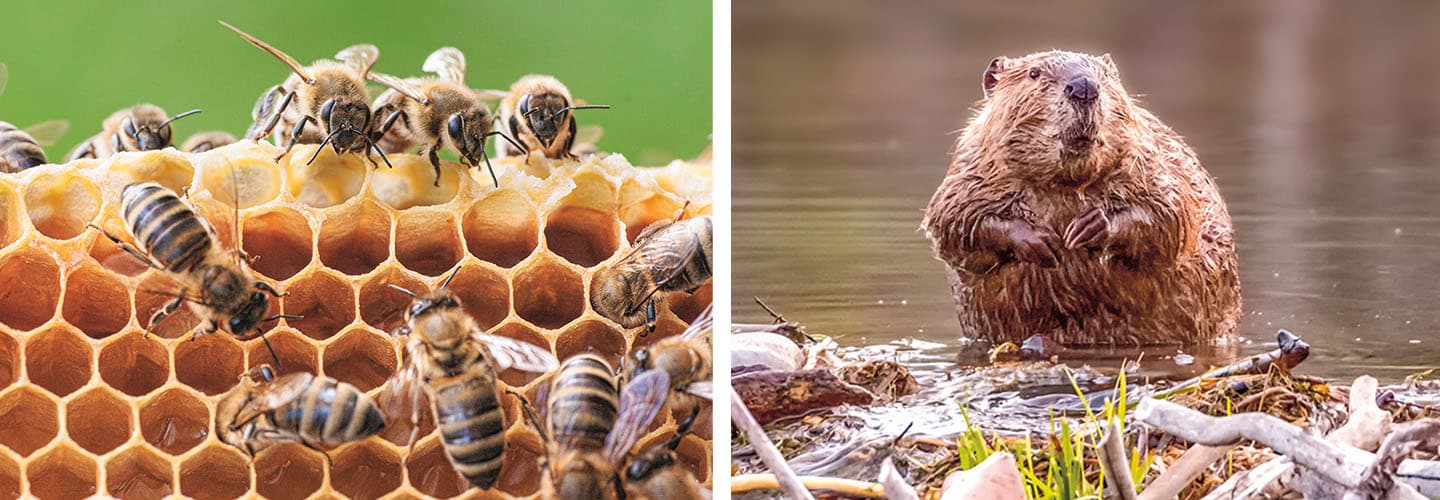

When it comes to smart design, bees are hard to beat. To build their hives, honeybees make hundreds of tiny wax cells in the shape of a hexagon. The tightly packed six-sided cells create a lightweight, incredibly strong structure called a honeycomb. It’s where bees raise their young and store honey and pollen, which they use to make food.
“What’s great about that six-sided shape is that it fits together perfectly using the least amount of material you need,” explains Andrew Howley. He’s an expert in biomimicry—the practice of getting ideas from nature to solve problems.
The honeycomb design inspired the NASA engineers who built the James Webb Space Telescope. Its huge mirror has 18 hexagonal sections that folded to fit into a rocket. When unfolded in space, the sections fit together tightly, enabling the mirror to collect as much light as possible from distant galaxies.