
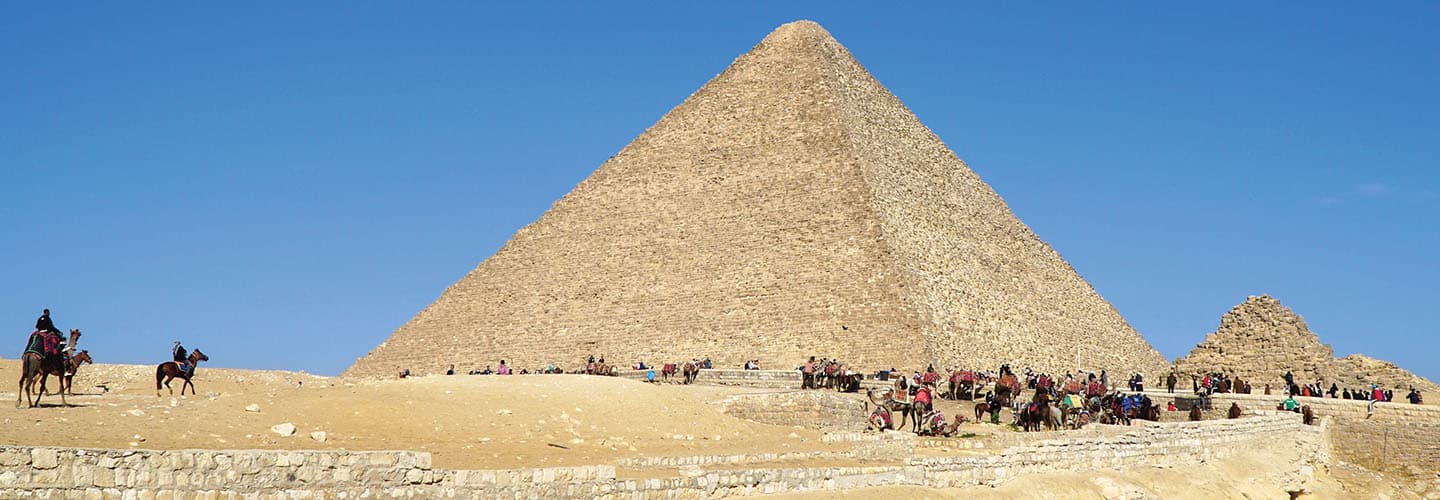

The Great Pyramid of Giza with visitors and camels gathered at its base

Construction on the Great Pyramid of Giza began around 2550 B.C.

Shutterstock.com

Standards

A Tour of The Great Pyramid

Thousands of years after it was built, the Great Pyramid of Giza remains one of the most amazing engineering projects in history. 

Jim McMahon/Mapman®

More than 4,500 years ago, workers in ancient Egypt began building a massive pyramid. It would become the tomb of a pharaoh, or ruler, named Khufu (KOO-foo). It was also one of the greatest achievements of Egyptian civilization. 

Over about two decades, tens of thousands of workers moved and placed more than 2 million stone blocks—without the machines we rely on today. When the Great Pyramid of Giza was finished, it stood 481 feet tall. For thousands of years, it was the tallest human-made structure on Earth.

“The fact that people were building something as big as a skyscraper so long ago makes the Great Pyramid really awesome,” says archaeologist Mark Lehner, who studies Egyptian pyramids. 

How did ancient Egyptians do it? That question has puzzled experts for centuries. Here’s what they know so far about the sophisticated process.

Let’s Go to Egypt
Watch a video to learn more about this country in northeast Africa.

A Lost Waterway

Today the Great Pyramid is surrounded by sand. But the area looked much different when the pyramid was being built. In 2024, researchers announced that they had located a long-lost branch of the Nile River that had dried up thousands of years ago. It once flowed near the pyramid. 

This 40-mile waterway acted as a superhighway in ancient Egypt. It allowed workers to bring huge stone blocks and other building materials by boat from across the kingdom to the pyramid site. The cargo was unloaded near the base of a construction ramp.

Illustrations by Julia Mozharovskaya

Note: The pyramid illustration is not drawn to scale. 

What’s Inside

Corridors, or passageways, inside the pyramid lead to the king’s burial chamber. It holds Khufu’s sarcophagus, or stone coffin. Above the chamber are rows of heavy blocks of granite and an angled roof. They support the weight of the rest of the pyramid above the chamber. 

How exactly these huge inner stones were put into place is still a mystery. But for thousands of years, they’ve prevented the pyramid from collapsing. Today visitors can walk through the corridors, in the footsteps of the ancient engineers who built the pyramid.

Ramped Up

Experts agree that the ancient Egyptians used a ramp system to move the huge stone blocks that make up the pyramid. Some blocks weigh up to 33,000 pounds—that’s heavier than a school bus!

Lehner explains that the ramps were likely made with gravel and desert clay. On top of the ramps, workers placed beams of wood arranged like railroad tracks. They covered the beams with clay and water, which made them slippery. This allowed workers to more easily pull the stones up the ramps on wooden sleds.

1. Based on the article, why is the Great Pyramid considered “one of the greatest achievements of Egyptian civilization”?

2. What does the author mean when she writes that the Nile River acted as a superhighway in ancient Egypt?

3. Why do experts think the blocks of granite above the burial chamber are important to the pyramid’s structure?

videos (2)
videos (2)
Skills Sheets (3)
Skills Sheets (3)
Skills Sheets (3)
Games (1)
TEACHER SUPPORT (1)
Text-to-Speech