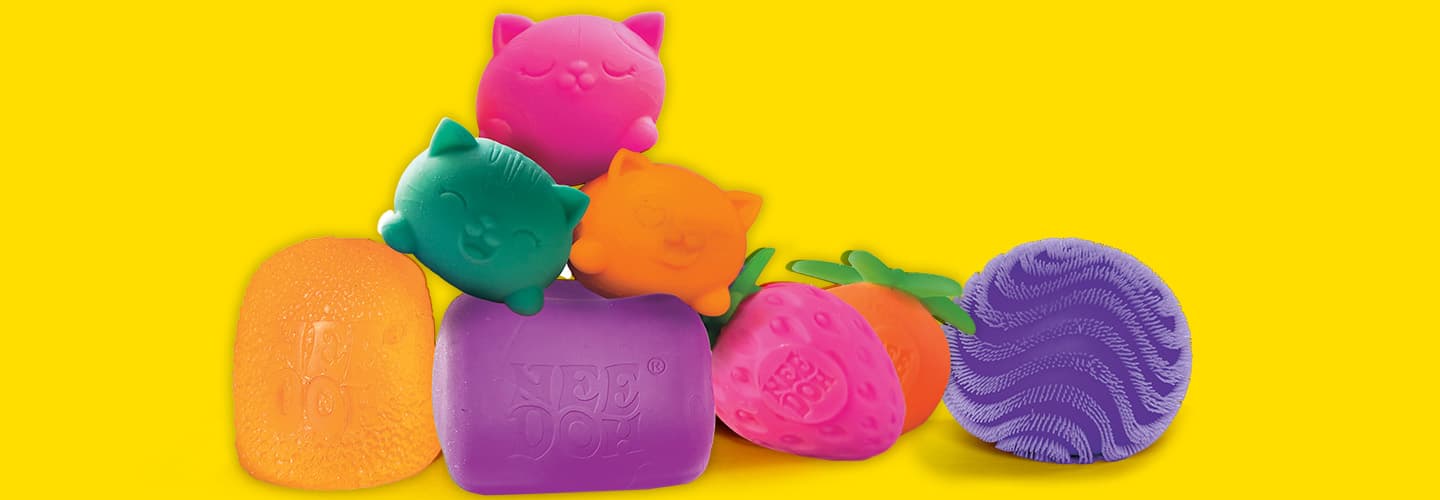

A collection of colorful Nee Doh squishy toys in cat and fruit shapes on a yellow background

Whitney Highfield 

Standards

How These Toys Took Over

What made NeeDohs must-have toys for kids across the country? 

Courtesy of family 

D’Angelo Adams

This past spring, D’Angelo Adams was hunting for a Dream Drop. He hoped to find the sparkly NeeDoh in the shape of a raindrop at Target. But when he and his mom got to the store, a worker gave them the same answer they had heard many times before. NeeDohs were sold out.

“People really, really want them,” says the 10-year-old from East Chicago, Indiana.

NeeDohs have been around since 2017. But interest in the squishy sensory toys exploded last year as videos of people squeezing and stretching them spread on social media.

Before long, NeeDohs were almost impossible to find. Customers waited in long lines before stores opened, hoping to get their hands on one. Some shipments sold out the same day they arrived in stores. Google searches for “NeeDoh” hit an all‑time high in April. The simple toy had become the biggest fad of the year. 

A Need for NeeDohs

A fad is anything that becomes extremely popular for a short time. It can be an activity, like saying “6-7,” or a product, like Labubus. Toy fads are nothing new (see “Gotta Have It!”). But social media has changed how quickly they can spread. 

NeeDohs’ bright colors and satisfying squishiness made videos of them especially fun to watch. After seeing just a few clips, kids like D’Angelo were flooded with more NeeDoh video recommendations on YouTube. Even videos of people searching for the newest versions of the squishy toys went viral. 

As excitement grew online, it spread in real life too. Kids talked about NeeDohs at school, and parents scrambled to find them in stores and online. 

Experts say that’s not surprising. The harder a popular item is to find, the more people want it. When kids see that their classmates have the newest toy, it’s common to feel FOMO, or the fear of missing out.

“Kids are always searching for ways to feel included,” says Jennifer Lynch. She’s an expert on toy trends who works for the Toy Association. “When you have that same toy as somebody else, you are part of that community.” 

What Is a Fad?
Watch a video about super-popular toys.

Squishies in School

Some people consider fidget toys like NeeDohs to be more than just playthings. D’Angelo says squeezing the colorful blobs helps him relieve stress and pay better attention in class.

“I feel focused and calmed down,” he explains. 

But some teachers say NeeDohs cause too many distractions. Last school year, D’Angelo’s fourth-grade teacher allowed them in class, but she changed her mind after some NeeDohs exploded when students squeezed them too hard. Many schools have banned the squishy toys.

“There’s a time and a place for fidget toys,” Lynch explains. “It’s just a matter of how kids are using them.” 

What’s Next?

Will kids still be squeezing NeeDohs years from now? No one knows. Not all toy crazes are the same. Some seem to fizzle out almost as quickly as they arrive. Others, like Barbie and the Rubik’s Cube, become long-lasting favorites. 

For now, D’Angelo is still searching for the newest NeeDohs. He says he’ll go anywhere to find them—as long as his mom will take him.

“Sometimes you have to go hours away,” D’Angelo says. “It’s very hard. But it’s exciting.”

1. Based on the article, what makes something a fad?

2. Why do some kids argue that they should be allowed to use fidget toys like NeeDohs in class?

3. What is the purpose of the sidebar, “Gotta Have It!”?

videos (2)
videos (2)
Skills Sheets (3)
Skills Sheets (3)
Skills Sheets (3)
Games (1)
TEACHER SUPPORT (1)
Text-to-Speech