
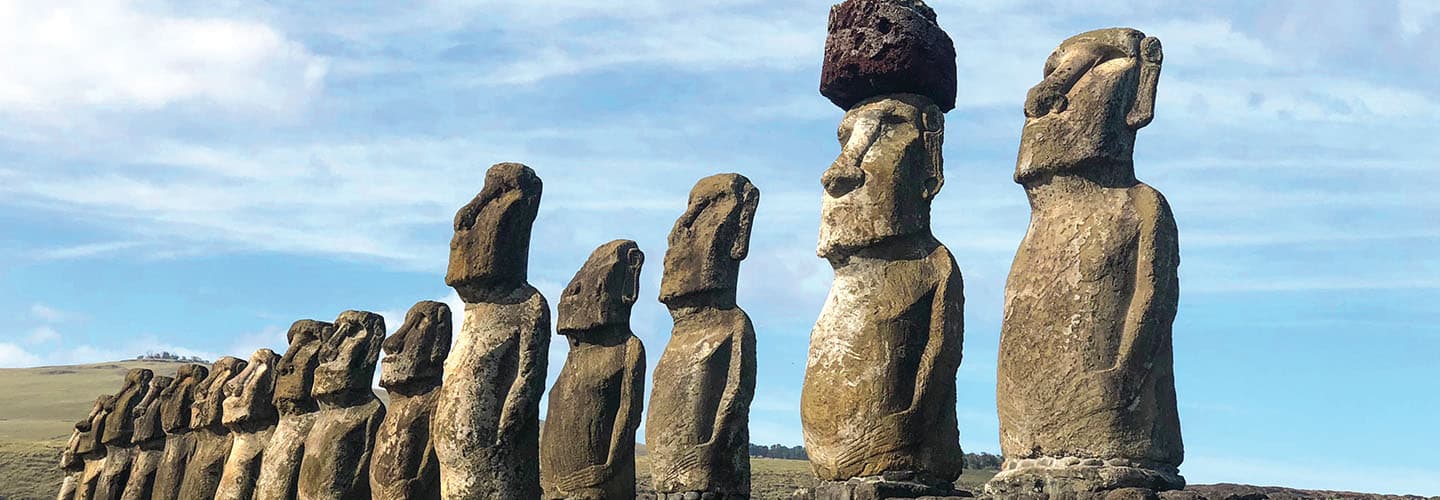

The real moai represent ancient religious leaders.

Mihelich Photography/500px/Getty Images

Standards

Mystery Solved?

The Mysteries of Easter Island
Watch a video to learn more about the statues of Easter Island.

Jim McMahon/Mapman®

In the middle of the Pacific Ocean, more than 900 statues stand guard over a small island. The towering stone statues are called moai (MOH-eye). They’re the most famous residents of Easter Island. The remote island, also known as Rapa Nui (RAH-puh NOO-ee), is part of Chile, a country in South America. 

Experts believe that the Rapa Nui people carved the statues from an extinct volcano between 400 and 900 years ago. Then they moved the statues across the rocky island, as far as 11 miles. 

But the ancient Rapa Nui didn’t have modern machinery or even wheels. So how did they move the statues? On average, the moai weigh 28,000 pounds and stand 13 feet tall. One theory is that the Rapa Nui laid the statues on wooden sleds and dragged them. But researchers recently showed that the moai may have “walked.”

Carl Lipo 

Researchers use three ropes to slowly “walk” the moai model forward. 

On the Move

A team from the University of Arizona and Binghamton University in New York built a life-sized model of a moai. The researchers wanted to test the idea that the Rapa Nui used ropes and their own strength to move the statues. The team attached ropes to the head of the moai model, then rocked it from side to side. This slowly moved the statue forward, as if it were walking. They moved the moai about 328 feet in 40 minutes.

Binghamton University professor Carl Lipo was one of the leaders of the project. He says transporting the real moai was an amazing achievement.

“It shows that the Rapa Nui people were incredibly smart,” Lipo says. “We have a lot to learn from them.”

videos (2)
videos (2)
Games (1)
Text-to-Speech