
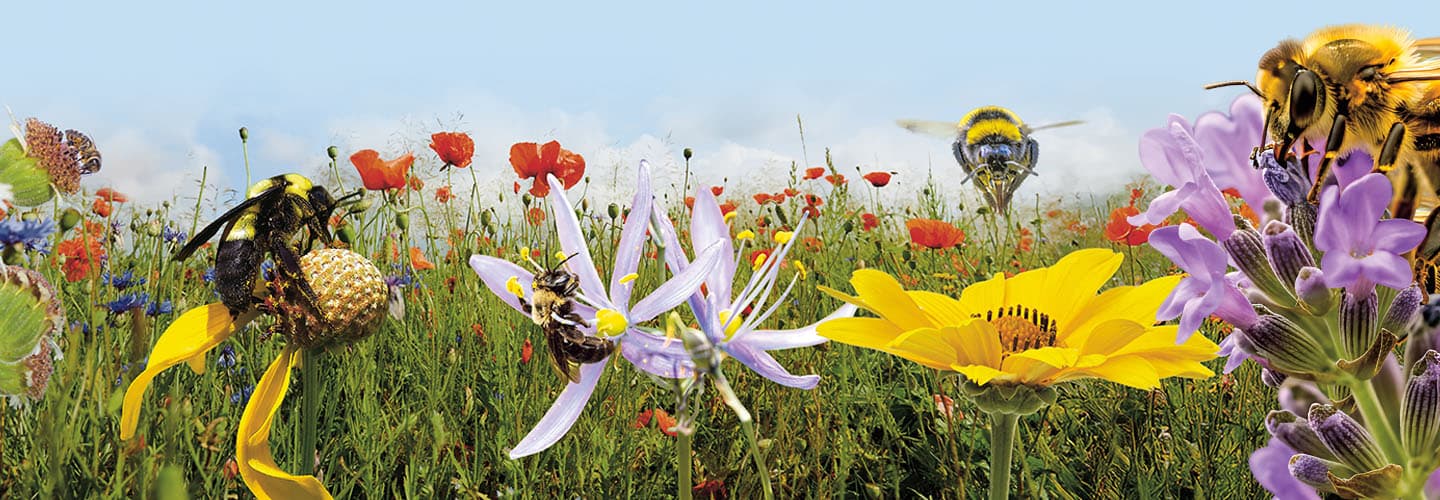

From left to right: Hawaiian yellow-faced bee; Southern plains bumblebee; Franklin’s bumblebee; Rusty-patched bumblebee; Honeybee

the_burtons/Getty Images (field); Doug Perrine/Alamy Stock Photo (Hawaiian yellow faced bee); piemags/nature/Alamy Stock Photo (Southern plains bumblebee); Janet Horton/Alamy Stock Photo (Franklin’s bumblebee); Shutterstock.com (all other images)

Standards

Feeling the Sting

Huge numbers of bees are fighting to survive. What can we do to keep them buzzing? 

As You Read, Think About: How would the world be different without bees?

Buzz, buzz. Last June, Seth Christian spotted a bee near a patch of purple flowers in Wenatchee, Washington. He swept his net over the bee and put it in a container. After taking photos, Christian set the insect free.

He volunteers with the Xerces Society, an organization that works to protect insects. Christian tracks and counts bees, helping scientists identify bee species that are under threat. 

The insect he caught that day was a western bumblebee. The population of this species in the United States dropped by 57 percent from 1998 to 2020. 

It’s just one of many bee species facing serious decline. As a farmer, Christian knows how crucial all bees are. 

“They’re just so important to so many of my crops,” he says. 

And it’s not just crops that need bees. The tiny insects are vital to the overall health of the environment.

Buzz, buzz. Last June, Seth Christian spotted a bee. It was near some purple flowers in Wenatchee, Washington. He swept his net over the bee. Then he put it in a container. After taking photos, Christian set the insect free. 

He volunteers with the Xerces Society. That’s an organization that works to protect insects. Christian tracks and counts bees. This helps scientists identify bee species that are under threat.

The insect he caught that day was a western bumblebee. The population of this species in the United States fell from 1998 to 2020. It dropped by 57 percent. 

It’s just one of many bee species in serious decline. As a farmer, Christian knows how crucial all bees are.

“They’re just so important to so many of my crops,” he says.

And it’s not just crops that need bees. The tiny insects are vital to the overall environment.

The Buzz on Bees
Watch a video to learn more about these important pollinators.

Busy Bees

When many people think of bees, they picture a hive of honeybees humming with activity (see “The Buzz on Honeybees”). But there are more than 4,000 bee species in the U.S., and they’re not all alike. Many types of bumblebees live in groups in underground nests. Carpenter bees live alone and build their nests in wood. And some species of sweat bees are green or blue. 

Despite differences in size, color, and behavior, all bees share an important job: pollination. They transfer powdery grains called pollen between flowers, which helps plants reproduce (see page 8). Many animals rely on the seeds, leaves, and fruit from those plants to survive.

“There would just be a lot fewer plants and a lot fewer animals around without bees,” says T’ai Roulston. He’s a bee expert and professor at the University of Virginia. 

Without bees, there would also be huge shortages of apples, carrots, and many other fruits and vegetables. Experts estimate that pollinators like bees are responsible for one out of every three bites of food we eat.

When many people think of bees, they picture a hive of honeybees (see “The Buzz on Honeybees”). But there are more than 4,000 bee species in the U.S. And they’re not all alike. Many types of bumblebees live in groups in underground nests. Carpenter bees live alone and build their nests in wood. And some sweat bees are green or blue.

Bees are different in size, color, and behavior. But all bees share an important job: pollination. They spread powdery grains called pollen between flowers. This process helps plants reproduce (see page 8). Many animals rely on the seeds and fruit from those plants to survive.

“There would just be a lot fewer plants and a lot fewer animals around without bees,” says T’ai Roulston. He’s a bee expert and professor at the University of Virginia.

Without bees, there would be huge shortages of crops. These include apples, carrots, and many other fruits and vegetables. According to experts, pollinators like bees are responsible for one out of every three bites of food we eat.

Bees At Risk

That’s why the decline in bees is so alarming. In North America, about 35 percent of native bee species are at risk of extinction. 

One major threat is habitat loss. Bees need to eat from a variety of flowers to stay healthy. But many fields and meadows have been cleared for farmland, roads, and buildings.

Pesticides are another danger. Farmers spray these chemicals to protect crops from harmful insects, but they can also end up killing bees.

Honeybees, which aren’t native to the U.S., pose a problem too. They can spread diseases to other bees and compete with them for food.

That’s why the decline in bees is so alarming. In North America, about 35 percent of native bee species are at risk of extinction.

One major threat is habitat loss. Bees need to eat from a variety of flowers. But many fields have been cleared for farmland and buildings.

Pesticides are another threat. Farmers spray these chemicals to protect crops from harmful insects. But they can also kill bees.

Honeybees, which aren’t native to the U.S., pose a problem too. They can spread diseases to other bees. They also compete with them for food.

Shifting Focus

In recent years, much of the news about bees has been about the loss of honeybee colonies. Since 2006, tens of millions of honeybees have died. 

But scientists say honeybees aren’t likely to disappear. Unlike native bees, honeybees can be bred by beekeepers.

Experts aren’t suggesting we ignore honeybees. Instead, they urge us to protect all bees. One way to help is to plant native flowers. That’s what Christian did. He also takes time to watch the tiny creatures at work.

“Wherever you’re at, there’s something amazing happening,” Christian says. “And it might be really small.”

For years, news about bees has focused on the loss of honeybee colonies. Since 2006, tens of millions of honeybees have died.

But scientists say honeybees likely won’t disappear. Unlike native bees, honeybees can be bred by beekeepers.

Experts don’t suggest we ignore honeybees. Instead, they urge us to protect all bees. What’s one way to help? Plant native flowers. That’s what Christian did. He also takes time to watch the tiny creatures at work.

“Wherever you’re at, there’s something amazing happening,” he says. “And it might be really small.”

The Buzz on Honeybees

  • Colonies live in hives that can include tens of thousands of honeybees.
  • The most common type in the U.S. is the western honeybee. It’s originally from Europe, Africa, and parts of Asia.
  • In the U.S., honeybees pollinate more than 100 crops, including broccoli, many types of berries, and all of our almond crops.
  • The queen bee is the leader of the hive. She lives up to five years and can lay up to 2,500 eggs a day.
  • It takes 12 worker bees their entire lives to make a single teaspoon of honey. 
  • Colonies live in hives that can include tens of thousands of honeybees.
  • The most common type in the U.S. is the western honeybee. It’s originally from Europe, Africa, and parts of Asia.
  • In the U.S., honeybees pollinate more than 100 crops, including broccoli, many types of berries, and all of our almond crops.
  • The queen bee is the leader of the hive. She lives up to five years and can lay up to 2,500 eggs a day.
  • It takes 12 worker bees their entire lives to make a single teaspoon of honey. 

Cavan Images/Brenda Howe/Getty Images

1. How does the author support the claim that pollination is an “important job”?

2. Based on the article, what are three factors that have caused North America’s native bee populations to decline?

3. What is the purpose of the sidebar, “The Buzz on Honeybees”?

1. How does the author support the claim that pollination is an “important job”?

2. Based on the article, what are three factors that have caused North America’s native bee populations to decline?

3. What is the purpose of the sidebar, “The Buzz on Honeybees”?

videos (4)
videos (4)
videos (4)
videos (4)
Skills Sheets (3)
Skills Sheets (3)
Skills Sheets (3)
Games (1)
TEACHER SUPPORT (1)
Leveled Articles (1)
Text-to-Speech