
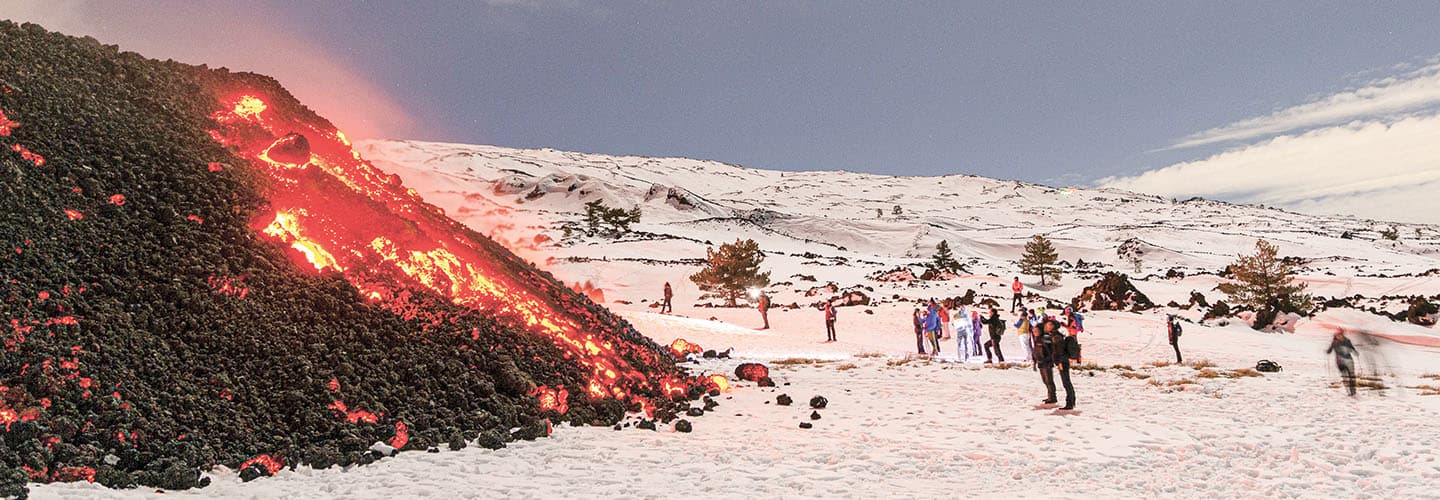

People observe glowing red lava flowing down a snow-covered volcanic slope

People gather near a slow-moving lava flow on snow-covered Mount Etna in February 2025. 

Salvatore Allegra/Anadolu via Getty Images

Standards

Playing With Fire

Millions of people visit active volcanoes each year, some getting near enough to feel the lava’s heat. But how close is too close?

As You Read, Think About: How can tourists stay safe when visiting volcanoes?

In June 2025, a peaceful day on the Italian island of Sicily turned scary. As tourists snapped selfies at Mount Etna, the volcano suddenly roared to life. A huge cloud of ash, rocks, and gas shot into the air, causing people to race down the mountain in a panic. Luckily, no one was injured.

After the volcano erupted again this past December, Italian officials put new safety restrictions in place.

Each year, about 1.5 million people visit Mount Etna, the most active volcano in Europe. It isn’t the only volcano drawing crowds. Worldwide, millions of people travel to active volcanoes. 

“They’re very exciting to visit,” says Jessica Ball. She’s a volcanologist (a scientist who studies volcanoes) at the U.S. Geological Survey. “And we want people to be able to enjoy them while also staying safe.”

In June 2025, a peaceful day turned scary on Sicily. That’s an Italian island. As tourists snapped selfies at Mount Etna, the volcano suddenly roared to life. A huge cloud of ash, rocks, and gas shot into the air. People were in a panic. They raced down the mountain. Luckily, no one was hurt.

The volcano erupted again this past December. So Italian officials put new safety restrictions in place.

Each year, about 1.5 million people visit Mount Etna. It’s the most active volcano in Europe. And it isn’t the only volcano drawing crowds. Worldwide, millions of people travel to active volcanoes. 

“They’re very exciting to visit,” says Jessica Ball. She’s a volcanologist, a scientist who studies volcanoes. She works at the U.S. Geological Survey. “And we want people to be able to enjoy them while also staying safe,” she adds.

What You Need to Know About Volcanoes
Watch a video to learn more about the fiery wonder of volcanoes.

Chasing Lava

Not all volcanoes are alike. Mount Etna is a stratovolcano. It has steep sides, and its eruptions can be huge, violent explosions. The ash cloud from Etna’s June 2025 eruption, for example, was about 4 miles high. 

Shield volcanoes, on the other hand, have gentler slopes, and lava tends to flow out slowly from them. Their eruptions sometimes light up the sky like fireworks but usually aren’t nearly as powerful as those of stratovolcanoes. Kilauea (kee-lah-WAY-ah), in Hawaii, is a shield volcano (see “America’s Hottest Spot”). 

Keaton Terry, a college student who’s visited about 30 volcanoes, says there’s nothing quite like seeing an eruption in person.

“It’s unforgettable,” he explains. “It’s one of the most impressive natural displays on Earth.” 

Not all volcanoes are alike. Mount Etna is a stratovolcano. It has steep sides. And it can erupt in huge, violent explosions. Take the ash cloud from Etna’s June 2025 eruption, for example. It was about 4 miles high. 

Shield volcanoes, on the other hand, have gentler slopes. Lava tends to flow out slowly from them. Their eruptions sometimes light up the sky like fireworks. But they usually aren’t as powerful as stratovolcano eruptions. Kilauea (kee-lah-WAY-ah), in Hawaii, is a shield volcano (see “America’s Hottest Spot”). 

Keaton Terry is a college student who has visited about 30 volcanoes. He says there’s nothing like seeing an eruption in person.

“It’s unforgettable,” he says. “It’s one of the most impressive natural displays on Earth.”

Tourism Turns Risky

As stunning as eruptions are, they can also be dangerous. Lava can reach temperatures of nearly 2,300 degrees Fahrenheit. That’s hot enough to burn your skin instantly and start fires. Plus, volcanoes often release poisonous gases that may damage people’s lungs. Sightseers can also get hit by flying rocks.

To prevent injuries, officials at Etna, Kilauea, and other active volcanoes have set up viewing areas a safe distance from the action. They recommend taking other precautions too, such as wearing face masks and identifying escape routes in case of an emergency.

“You want to be aware of what’s happening around you, not just focused on your camera,” Ball advises.

She explains that volcanoes usually show warning signs that they’re going to erupt. These may include small earthquakes, changes in the volcano’s shape, and the release of more gas. When scientists think a volcano will erupt soon, they work with local governments to alert the public and update safety guidelines.

Eruptions are stunning. But they can also be dangerous. Lava is nearly 2,300 degrees Fahrenheit. That’s hot enough to burn your skin instantly and start fires. Plus, volcanoes often release poisonous gases. That can damage people’s lungs. Visitors can also get hit by flying rocks.

To prevent injuries, officials at volcanoes like Etna and Kilauea have set up viewing areas away from the action. They recommend taking other precautions too. These include wearing face masks and identifying escape routes. 

“You want to be aware of what’s happening around you, not just focused on your camera,” Ball says.

She explains that volcanoes usually show signs that they’re going to erupt. These include small earthquakes, changes in the volcano’s shape, and the release of more gas. When scientists think a volcano will erupt soon, they work with local governments. Together they alert the public and update safety instructions.

Safety First

Still, eruptions can happen without warning—as Mount Etna did last June. To help keep visitors safe, one of the new rules requires them to stay at least 660 feet (about the length of two football fields) away from Etna’s flowing lava. The rules also prohibit tours after dusk, which many people consider to be the best time to view the lava. 

Many tour guides say the rules are too strict and are hurting their business. They argue that their tours are safe because they only take groups near lava that is moving very slowly. 

Experienced volcano visitors, like Terry, take safety seriously. He says it’s important to follow all rules and the latest guidance from scientists and park officials.

“Volcano tourism can be safe and educational,” Terry says, “but only if people respect nature’s power.”

Still, eruptions can happen without warning. That was the case with Mount Etna last June. To keep visitors safe, a new rule requires them to stay at least 660 feet away from Etna’s flowing lava. That’s about the length of two football fields. The rules also ban tours after dusk. Many people consider that to be the best time to view the lava. 

Many tour guides say the rules are too strict. They say the rules are hurting their business. They argue that their tours are safe since they only take groups near slow-moving lava. 

Experienced visitors, like Terry, take safety seriously. He says it’s important to follow all rules and listen to scientists and officials.

“Volcano tourism can be safe and educational,” Terry says, “but only if people respect nature’s power.”

America’s Hottest Spot

Each year, visitors from around the world flock to Hawaii Volcanoes National Park, hoping to see Kilauea’s fiery lava flows up close. They often get to see a spectacular show. That’s because Kilauea is one of the world’s most active volcanoes. It erupted nonstop from 1983 to 2018. It has burst back to life on and off since then—including this year.

Kilauea is one of five volcanoes that make up what’s known as the Big Island of Hawaii. Thanks to Kilauea, the Big Island is getting bigger. Lava from a 2018 eruption added land the size of about 660 football fields. The lava flows from the volcano to the sea, where it cools and hardens to form new land along the coast.

Each year, visitors from around the world flock to Hawaii Volcanoes National Park, hoping to see Kilauea’s fiery lava flows up close. They often get to see a spectacular show. That’s because Kilauea is one of the world’s most active volcanoes. It erupted nonstop from 1983 to 2018. It has burst back to life on and off since then—including this year.

Kilauea is one of five volcanoes that make up what’s known as the Big Island of Hawaii. Thanks to Kilauea, the Big Island is getting bigger. Lava from a 2018 eruption added land the size of about 660 football fields. The lava flows from the volcano to the sea, where it cools and hardens to form new land along the coast.

Gary Miller/Getty Images

People watch as Kilauea erupts in May 2025.

1. Do you think “Playing With Fire” is a good title for the article? Explain.

2. What are some steps that officials have taken to try to keep volcano tourists safe?

3. Based on the diagram “Inside an Eruption” on page 8, what is the difference between magma and lava?

1. Do you think “Playing With Fire” is a good title for the article? Explain.

2. What are some steps that officials have taken to try to keep volcano tourists safe?

3. Based on the diagram, “Inside an Eruption,” what is the difference between magma and lava?

videos (2)
videos (2)
Skills Sheets (3)
Skills Sheets (3)
Skills Sheets (3)
Games (1)
TEACHER SUPPORT (1)
Leveled Articles (1)
Text-to-Speech