
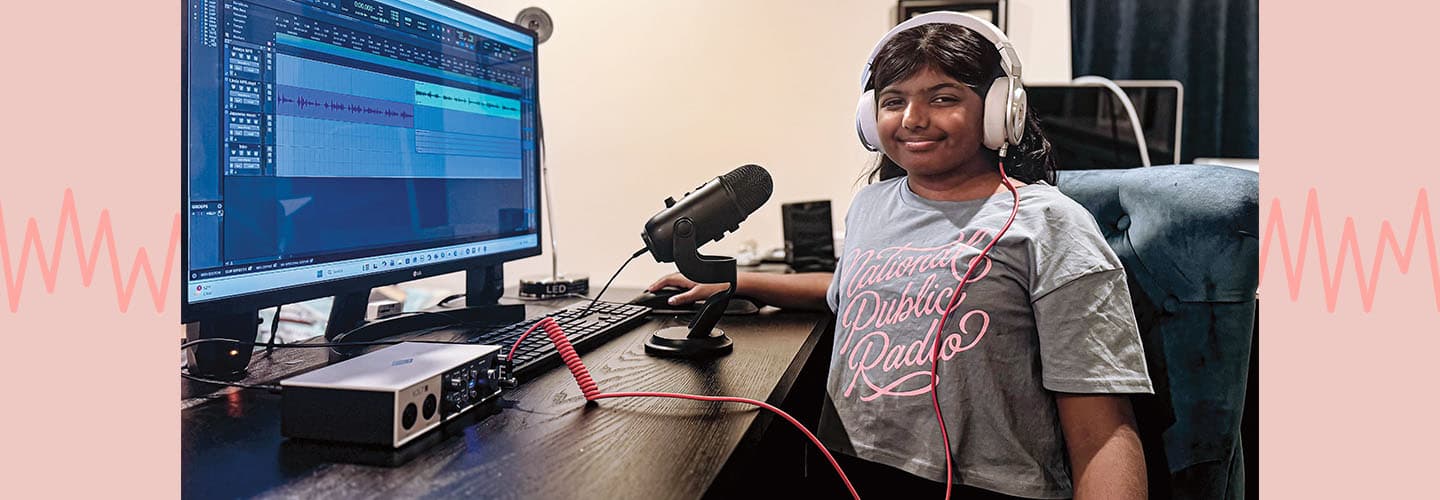

A girl wearing headphones sits at a desk with audio editing software and a microphone

Shutterstock.com (background); Courtesy Desai family (Ameya Desai)

Standards

I Keep History Alive 

In her award-winning podcast, Ameya Desai wants to make sure no one’s story is forgotten. 

As You Read, Think About: How does Ameya’s podcast help keep history alive?

Ameya Desai sat in front of a microphone with her headphones on. Her notes lay on the desk in front of her. Ameya was about to record her first podcast in her home studio in San Jose, California, in 2024.

On the phone, Ameya’s grandfather Kishor Desai shared a painful story about how he came to live in the United States. Before Kishor was born, his parents had moved from India to Uganda, a country in East Africa. It was the only home Kishor had ever known. But in 1972, while he was in college, Uganda’s president ordered all Asian people to leave the country within 90 days. The Desai family was forced to find a new home.

Ameya’s dad teared up while listening to his father speak. Through her podcast, Ameya was uncovering details of their family history that even her dad had never heard.

Ameya’s podcast about her grandfather’s displacement didn’t just have a big effect on her family. In 2024, it was one of five fourth-grade winners in the NPR (National Public Radio) Student Podcast Challenge. Receiving that honor encouraged Ameya to create more episodes and turn the project into a full series.

“More people were willing to share their experiences,” Ameya says. “There’s history behind them that’s important, but it’s almost forgotten.”

The 11-year-old’s podcast is called Far From Home: Stories of Forced Migration. Ameya wants to share people’s stories before they fade away.

“I’m honored that they are able to get out there and reach a bigger audience,” she says.

Prisoners In Their Own Country
Watch a video to learn about American internment camps during WWII.

Far From Home

After her first episode was released, Ameya found her next story right next door. Her neighbor’s grandmother Linda Horikawa had lived on a farm in Cupertino, California, until she was 4. But in 1942, Horikawa and her family were among tens of thousands of Japanese Americans who were forced to live in prison camps (see “Prisoners at Home”). 

Ameya spent hours preparing for her interview. She visited a local museum to learn more. Then she carefully chose questions for Horikawa, who opened up to Ameya about what life was like in a prison camp.

“It struck a really deep chord with me because it’s not a story that’s well-known,” Ameya says. “It happened right here in my home state.” 

Courtesy Desai family

Ameya Desai (right) interviewed Linda Horikawa about her time in a prison camp.

History Lives On

All of Ameya’s preparation paid off. In the fall of 2025, her interview with Horikawa won the top prize in the middle school category of the NPR Student Podcast Challenge. The fifth-grader is the contest’s first two-time champion. Ameya, who has always loved to read and write, says creating her podcast has shown her the importance of good journalism.

“I see how it has a big impact on the world,” she says. “Sharing stories is something that needs to be done.”

For future episodes, Ameya plans to keep highlighting people from older generations whose stories aren’t widely known. And she hopes we’ll continue to learn from people like her grandfather and Horikawa.

“Their courage to tell me about their journeys gives me inspiration,” Ameya says. “And I feel like it’s up to us, our generation, to keep those stories moving.”

1. What is displacement? Describe Ameya’s grandfather’s experience with displacement.

2. Based on the article, how does Ameya prepare for her podcast interviews?

3. Why do you think the author chose the title “Prisoners at Home” for the article’s sidebar?

videos (2)
videos (2)
Skills Sheets (2)
Skills Sheets (2)
Games (1)
TEACHER SUPPORT (1)
Text-to-Speech