

Ali Moustafa/Getty Images

Standards

Ancient Egypt Comes Alive

Thousands of items are on display at a new museum that unlocks Egypt’s history. 

As You Read, Think About: How can museums help us better understand the past?

The Life and Death of the Boy King
Watch a video to travel back to when King Tut ruled Egypt.

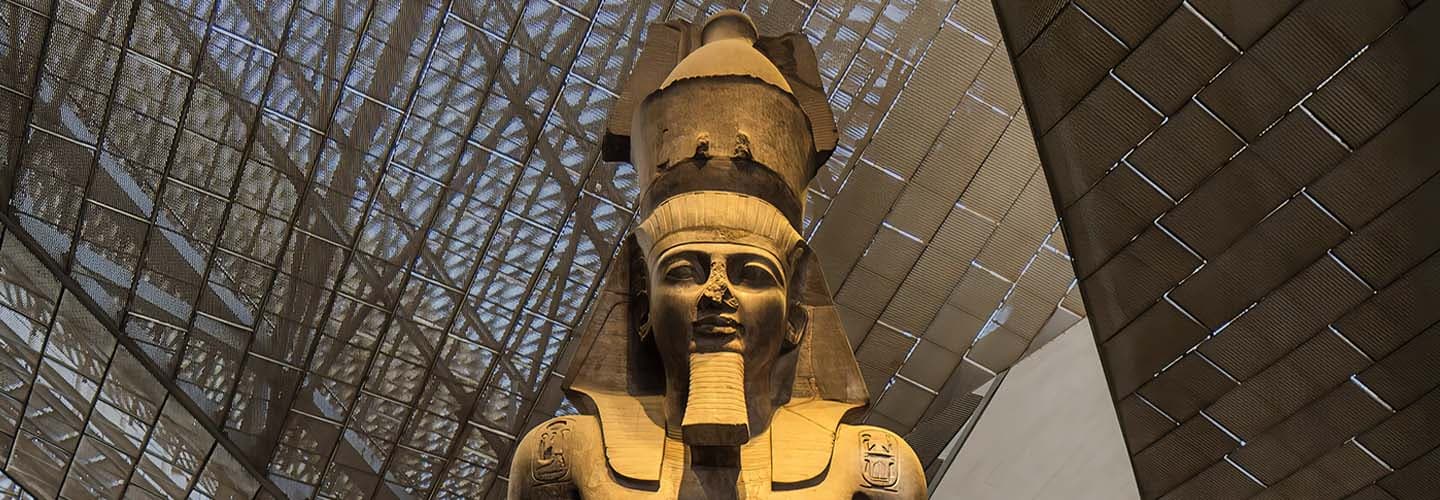
Step into the entrance hall of this new museum, and you’ll be greeted by a towering statue of Ramses II. He was one of the most powerful rulers of ancient Egypt. Next, you’ll climb a grand staircase lined with statues of other pharaohs. Then you’ll move on to rooms filled with colorful coffins, giant wooden boats, and sparkling gemstones. Finally, you’ll come face-to-face with one of the most famous artifacts in the world: the gold mask of King Tutankhamen (too-tahn-KAH-muhn), better known as King Tut.

Welcome to the Grand Egyptian Museum, which opened this past November in Giza, Egypt. It’s the world’s largest museum dedicated to one civilization.

Step into the hall of this new museum. You’ll be greeted by a giant statue of Ramses II. He was one of the most powerful rulers of ancient Egypt. Next, you’ll climb a grand staircase lined with statues of other pharaohs. Then you’ll move on to rooms filled with colorful coffins, giant boats, and sparkling gems. Finally, you’ll come face-to-face with one of the world’s most famous artifacts. It’s the gold mask of King Tutankhamen (too-tahn-KAH-muhn), better known as King Tut.

Welcome to the Grand Egyptian Museum. It opened this past November in Giza, Egypt. It’s the world’s largest museum devoted to one civilization.

Ali Moustafa/Getty Images

This statue of Ramses II is about 3,200 years old and stands roughly 36 feet tall.

Years in the Making

Egypt’s president announced plans for the museum in 1992. A site was chosen about a mile from the Great Pyramid of Giza. But turning the plans for the museum into a reality took decades. Construction finally began in 2005 and wasn’t finished until 2023. The Grand Egyptian Museum covers about 5.4 million square feet—an area larger than 90 football fields.

Building such a massive structure was only one challenge. Another was gathering all the artifacts to fill it. The museum includes thousands of treasures that were collected from other museums in Egypt and around the world. Restoring and cleaning the fragile, centuries-old items to be displayed also took years. 

The museum’s curators carefully chose artifacts to help tell the story of each period of ancient Egyptian history. As visitors move through the exhibits, they can learn about Egyptian gods, everyday life, and how people built pyramids thousands of years before modern machinery existed.

“It’s not just putting lots of pretty things up,” says Salima Ikram, a professor of Egyptology at the American University in Cairo, Egypt. “It’s what you come away learning from them.”

Egypt’s president announced plans for the museum in 1992. A site was chosen about a mile from the Great Pyramid of Giza. But making the museum a reality took decades. Construction began in 2005 and didn’t end until 2023. The Grand Egyptian Museum covers about 5.4 million square feet. That’s an area larger than 90 football fields.

Building such a huge structure was just one challenge. Another was gathering all the artifacts to fill it. The museum includes thousands of treasures. They were collected from other museums in Egypt and around the world. Restoring and cleaning the items to be displayed also took years. Many were fragile and centuries old. 

The museum’s curators chose artifacts carefully. The items would help tell the story of each period of ancient Egypt. As visitors move through the exhibits, they can learn about Egyptian gods and everyday life. They can observe how people built pyramids long before modern machines existed.

“It’s not just putting lots of pretty things up,” says Salima Ikram. She’s a professor of Egyptology at the American University in Cairo, Egypt. “It’s what you come away learning from them.”

From Tomb to Museum 

Jim McMahon/Mapman®

Even with so much to see, no exhibit has created as much excitement as the one devoted to Egypt’s legendary Boy King. Tut became pharaoh more than 3,300 years ago, when he was just 8 or 9 years old. His reign was cut short when he died a decade later.

Because ancient Egyptians believed in life after death, they preserved the bodies of their rulers as mummies. Tut was buried with his belongings—including jewelry, weapons, and games—so he could use them in the afterlife.

Tut’s tomb was hidden for centuries. But in 1922, British archaeologist Howard Carter discovered it in the Valley of the Kings, a royal burial ground near the Nile River (see map). Carter’s team spent 10 years carefully removing more than 5,500 artifacts.

Today only Tut’s mummy remains in his tomb. Everything else, from his clothes to his chariots, is at the Grand Egyptian Museum. While some of Tut’s treasures had been showcased in traveling exhibits in the past, all the artifacts are now on display together for the first time.

“It gives us a wonderful insight into what a royal tomb should contain,” Ikram explains. “And it tells us about Tut’s life and death.” 

She adds that the museum is so packed with history that every visitor can have a unique experience—whether they’re fascinated by kings or gods or the lives of everyday people.

“That’s what a museum visit should be, a personal journey of discovery,” says Ikram.

One exhibit has created the most excitement: the one devoted to Egypt’s legendary Boy King. Tut became pharaoh more than 3,300 years ago. He was just 8 or 9 years old then. His reign was cut short when he died a decade later.

Ancient Egyptians believed in life after death. So they preserved the bodies of their rulers as mummies. Tut was buried with his things—like jewelry, weapons, and games—so he could use them in the afterlife.

Tut’s tomb was hidden for centuries. But in 1922, British archaeologist Howard Carter discovered it. It was in the Valley of the Kings. That’s a royal burial ground near the Nile River (see map). Carter’s team spent 10 years carefully removing each item. There were more than 5,500 artifacts.

Today only Tut’s mummy remains in his tomb. Everything else, including his clothes and chariots, is at the Grand Egyptian Museum. Some of Tut’s treasures had been shown in traveling exhibits in the past. But all the artifacts are now on display together for the first time.

“It gives us a wonderful insight into what a royal tomb should contain,” Ikram says. “And it tells us about Tut’s life and death.” 

She adds that every visitor can have a unique experience, whether they’re fascinated by kings or everyday people. That’s because the museum is so packed with history. 

“That’s what a museum visit should be, a personal journey of discovery,” says Ikram.

Treasure Trove

Here’s a look at a few of the more than 100,000 artifacts that can be found in the Grand Egyptian Museum.

Here’s a look at a few of the more than 100,000 artifacts that can be found in the Grand Egyptian Museum.

Shutterstock.com

This small golden statue is believed to show the Egyptian god Horus. Often depicted with the head of a falcon, Horus was the god of the sun and the sky.

This small golden statue is believed to show the Egyptian god Horus. Often depicted with the head of a falcon, Horus was the god of the sun and the sky.

Business Wire via Getty Images

Among the items buried with King Tut were four miniature versions of his sarcophagus, or coffin. Each held one of Tut’s mummified organs (liver, lungs, stomach, or intestines) wrapped in linen.

Among the items buried with King Tut were four miniature versions of his sarcophagus, or coffin. Each held one of Tut’s mummified organs (liver, lungs, stomach, or intestines) wrapped in linen.

Berk Ozdemir/Alamy Stock Photo 

This statue represents a sphinx—a mythical creature with the body of a lion and the head of a human. The sphinx symbolized strength and wisdom. This one depicts King Amenemhat III.

This statue represents a sphinx—a mythical creature with the body of a lion and the head of a human. The sphinx symbolized strength and wisdom. This one depicts King Amenemhat III.

1. What were some of the challenges involved in creating the Grand Egyptian Museum?

2. Why did ancient Egyptians preserve the bodies of their rulers as mummies?

3. What does the article mean when it says that every visitor to the Grand Egyptian Museum “can have a unique experience”?

1. What were some of the challenges involved in creating the Grand Egyptian Museum?

2. Why did ancient Egyptians preserve the bodies of their rulers as mummies?

3. What does the article mean when it says that every visitor to the Grand Egyptian Museum “can have a unique experience”?

videos (2)
videos (2)
Skills Sheets (3)
Skills Sheets (3)
Skills Sheets (3)
Games (1)
TEACHER SUPPORT (1)
Leveled Articles (1)
Text-to-Speech