
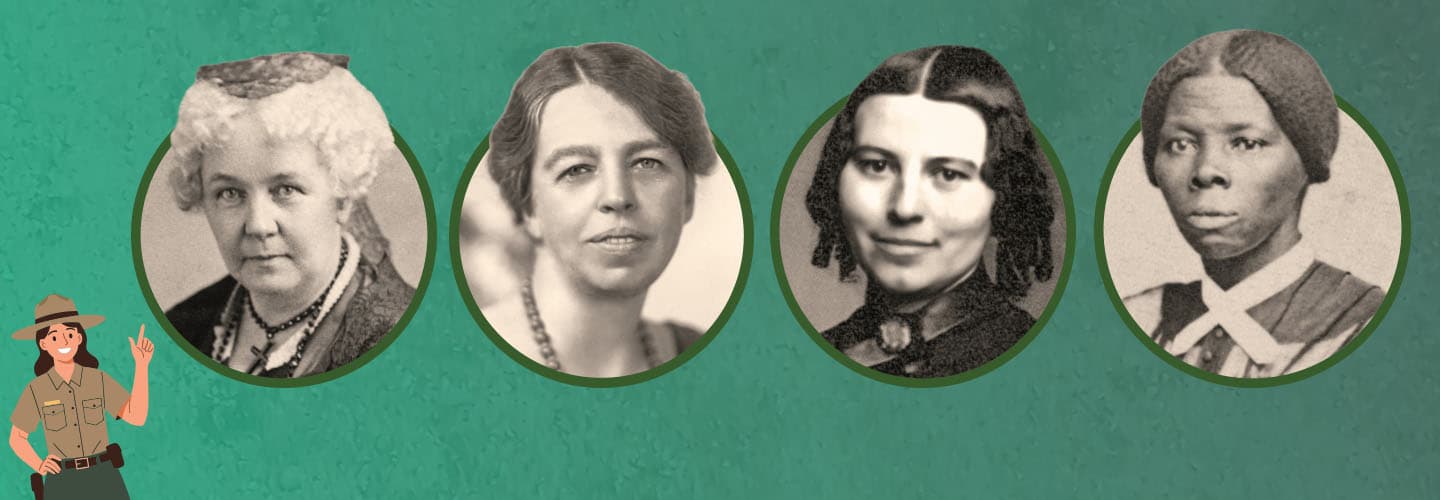

ZUMA Press, Inc./Alamy Stock Photo (Stanton); Stock Montage/Getty Images (Roosevelt); Science History Images/Alamy Stock Photo (Barton); Heritage Art/Heritage Images via Getty Images (Tubman); Shutterstock.com (all other images)

Standards

A Tour of Women's History

No matter where you go in the United States, chances are you’re not far from an important part of the nation’s past. The National Park Service manages more than 400 parks and other historical places. Here’s a look at five places that highlight the contributions of women to our nation’s 250-year history.

ZUMA Press, Inc./Alamy Stock Photo

Elizabeth Cady Stanton

Women’s Rights National Historical Park*

Seneca Falls, New York

Peter Lo Iacono/Alamy Stock Photo

This historical park includes Wesleyan Chapel (right), where the Seneca Falls Convention was held in 1848. This gathering of about 300 people was the first big public meeting about women’s rights in U.S. history. One of the organizers, Elizabeth Cady Stanton (1815-1902), read a document she had written called the Declaration of Sentiments. Modeled after the Declaration of Independence, it included the first official call for women’s suffrage, or right to vote.

Over the next 70 years, many more women joined the cause. Finally, in 1920, the 19th Amendment to the U.S. Constitution was ratified. It officially gave women across the country the right to vote.

*This national historical park also includes the homes of Elizabeth Cady Stanton and two other organizers of the women’s rights convention.

Stock Montage/Getty Images

Eleanor Roosevelt

Eleanor Roosevelt National Historic Site

Hyde Park, New York

Sandra Foyt/Alamy Stock Photo

Eleanor Roosevelt (1884-1962) greatly expanded the role of the first lady. Her husband, Franklin D. Roosevelt, was elected president at the height of the Great Depression. At the time, one-quarter of Americans were out of work. The first lady traveled around the country, talking with people who were struggling and checking on the progress of government relief programs. She was also the first wife of a president to hold press conferences and write her own newspaper column. 

After her husband’s death in 1945, Roosevelt didn’t slow down. She worked tirelessly for the rights of the poor, women, and people of color. 

Today visitors to her longtime home in New York, known as Val-Kill, can learn about her life and legacy.

Science History Images/Alamy Stock Photo 

Clara Barton

Clara Barton National Historic Site

Glen Echo, Maryland

Michael S. Williamson/The Washington Post via Getty Images

Clara Barton (1821-1912) was working in a government office in Washington, D.C., when the Civil War broke out in 1861. Though she had no training as a nurse, she delivered medical supplies and cared for wounded soldiers. Barton’s bravery earned her the nickname the “Angel of the Battlefield.”

Barton later founded the American Red Cross and served as its first president for 23 years. Her home in Maryland was the organization’s first permanent headquarters and is now a national historic site. Today the Red Cross continues to provide aid to victims of disasters.

Pictorial Press Ltd./Alamy Stock Photo

Rosie the Riveter

Rosie the Riveter WWII Home Front National Historical Park

Richmond, California

Zachary Frank/Alamy Stock Photo

During World War II (1939-1945), the U.S. government used a fictional character named Rosie the Riveter to encourage women to help the war effort. (A riveter is someone who fastens sheets of metal together using metal pins called rivets.) Millions of women answered the call, often taking jobs only men had done before. They went to work in factories, where they built weapons, planes, and warships. The historical park honoring these women is in Richmond, California, where they helped build more than 700 ships. 

The image of Rosie showing off her muscles remains a symbol of the strength and can-do spirit of women everywhere.

Heritage Art/Heritage Images via Getty Images

Harriet Tubman

Harriet Tubman National Historical Park 

Auburn, New York

Zachary Frank/Alamy Stock Photo

Harriet Tubman (1822-1913) was born into slavery in Maryland. It was one of 12 states where slavery was legal at the time. Enslaved people were treated like property. They had no rights and were forced to work without pay. In 1849, Tubman escaped to freedom by using the Underground Railroad. It was a secret network of people, routes, and hiding places. Tubman later risked her life as a “conductor” on the Railroad, leading hundreds of others to freedom. 

Two national historical parks honor the famous abolitionist. The one in Auburn, New York, includes a home where Tubman lived as a free woman. At the other, in Maryland, visitors can walk through the woods where she made her escape.

1. What happened at Wesleyan Chapel in 1848, and how did the event shape history?

2. Why was Clara Barton known as the “Angel of the Battlefield”?

3. What did the U.S. government hope to accomplish by creating the fictional character Rosie the Riveter?

videos (2)
videos (2)
Skills Sheets (2)
Skills Sheets (2)
Games (1)
TEACHER SUPPORT (1)
Text-to-Speech